
Solventless lamination has developed rapidly as an alternative to solvent-based processes. Its benefits include the absence of solvent residue, no solvent emissions, improved working conditions, lower energy use, high line speed and a smaller machine footprint.
Winlion supplied a complete control system to a manufacturer in this field. The single-station machine reaches 600 m/min; the twin-station model reaches 450 m/min.
The motion-control platform is 1500T / SIMOTION. Drive implementations include Yaskawa G1000 and Siemens G120, selected to suit different customer requirements.
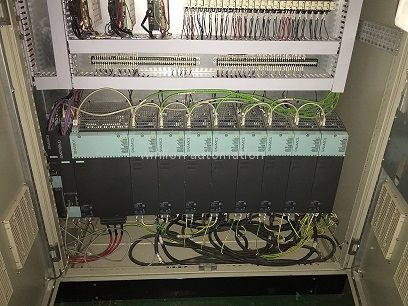
Tension control
The controller uses calculation models and filtering to estimate stable unwind and rewind diameters in real time. Electronic gearing provides the speed-loop reference, with dancer-potentiometer feedback used to regulate tension and provide a fast dynamic response.
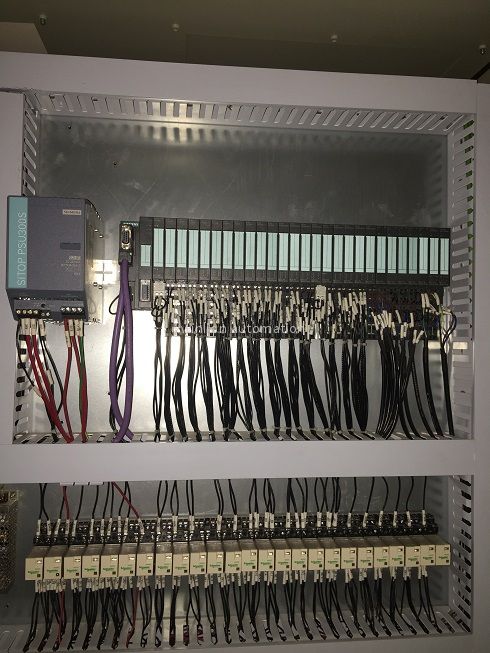
Gap-winding control
Rewind tension can use dancer or load-cell feedback. Multi-section taper-tension settings allow a different rate of tension reduction over each diameter range. The lay-on roller follows the calculated rewind diameter to maintain the web entry angle and support winding quality.
Roll-change and splice modes
The system supports semi-automatic full-speed non-stop splicing, fully automatic full-speed non-stop splicing, and non-stop splicing at a set reduced speed.
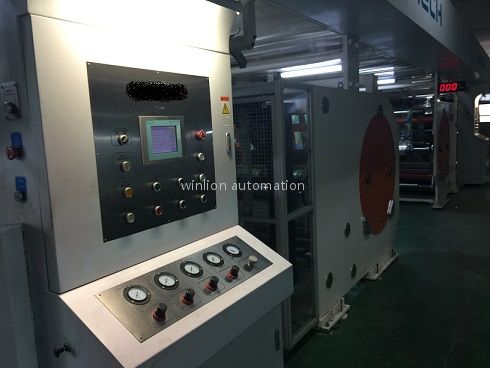
Remote maintenance
As control systems become more precise and complex, fault diagnosis becomes more demanding. Production sites still need a quick response. Winlion equips customer systems with remote-maintenance access so that engineers with an Internet connection can help diagnose faults and restore production from another location.