
We have worked in tension control for more than 20 years, with applications in film, paper, nonwovens and metal foil.
Tension control capabilities
- Stable operation at speeds up to 600 m/min
- High-speed roll changes on twin-station machines
- Automatic gap winding
- Tension control for unwinds, rewinds and intermediate web sections
- Centre winding, surface winding and combined centre/surface winding
- Centre differential winding
- Passive and driven unwinding
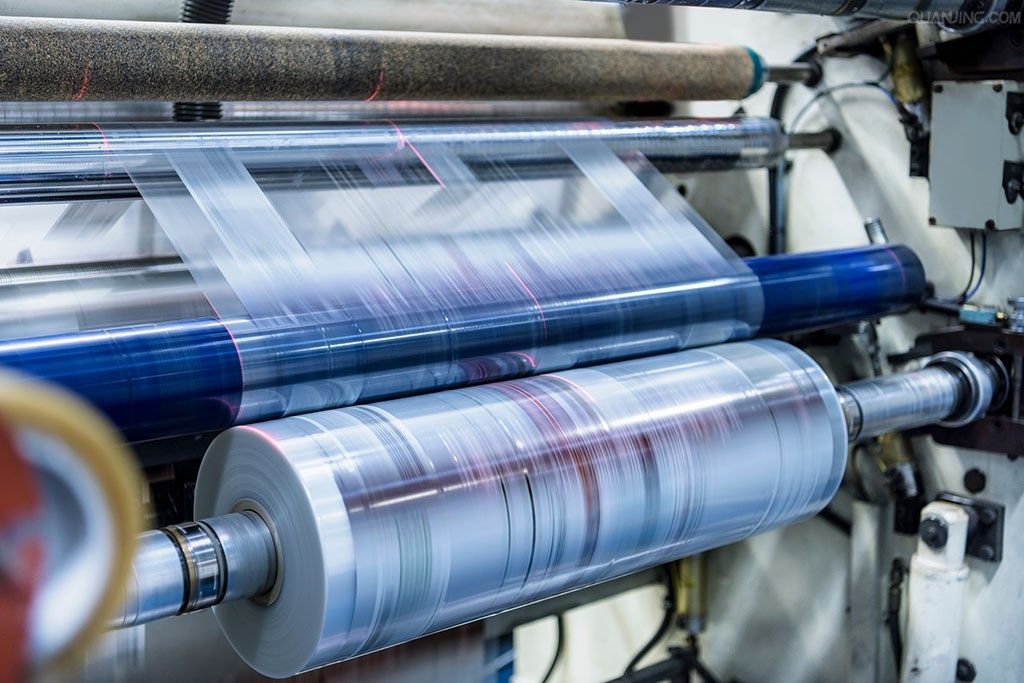
Tension control is important in paper, wire, film, adhesive tape, metal strip, steel sheet and metallurgical processing. In printing, poor tension control can cause registration errors, stretch the material, produce uneven roll edges, or leave a roll with a star-shaped or concave profile.
Web-handling processes generally require smooth material travel without unwanted stretching or deformation. We supply tension-control systems for these applications, with the control method selected for the process.
Centre-winding tension control
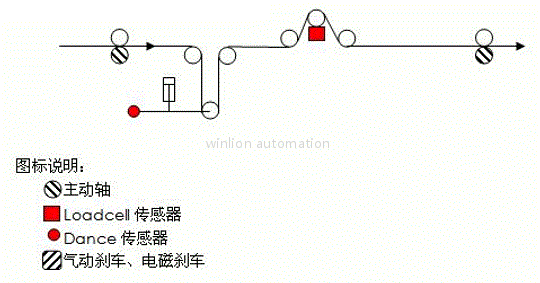
Centre winders commonly use a load cell or dancer for feedback, with a vector drive or servo as the actuator. Some applications use a clutch. Open-loop control without tension feedback is also used on slitters.
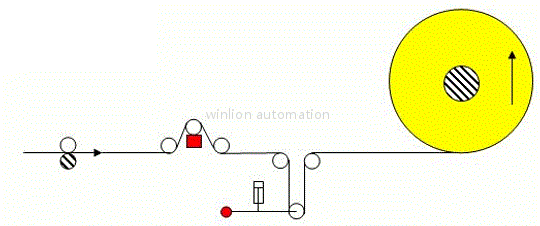
Passive-unwind tension control
A magnetic-particle brake or pneumatic brake produces the required web tension.
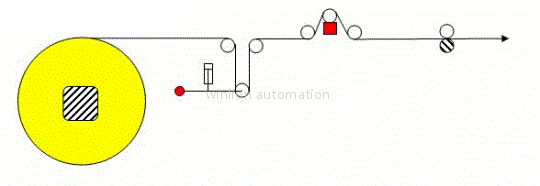
Driven-unwind tension control
Most driven unwinds use a vector drive or servo. To maintain tension, the motor normally operates in a generating condition. Braking resistors can dissipate this energy; regenerative arrangements can instead supply the energy to the rewind drive or feed it back to the mains.
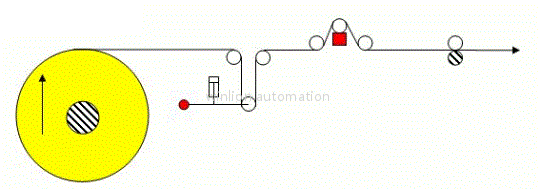
Tension between driven rollers
Vector or servo drives are commonly used to control the tension between driven web sections. Some arrangements use a brake on the downstream section.
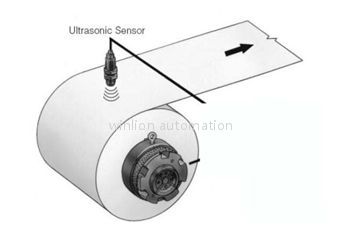
Ultrasonic diameter measurement: open-loop control
An ultrasonic sensor measures roll diameter. There is no tension feedback, so this is an indirect, open-loop method for applications with less demanding tension requirements.
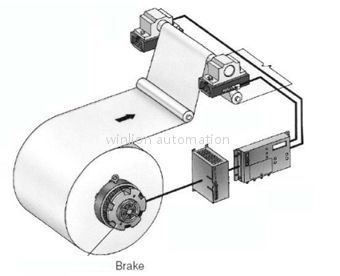
Load-cell feedback
A load cell measures web tension and sends the result to the controller. This is direct, closed-loop tension control, used where greater tension accuracy is required.
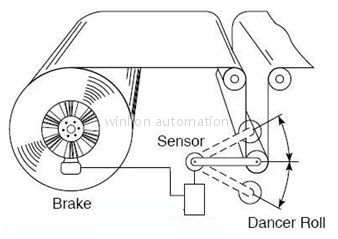
Dancer feedback
Dancer position indicates changes in web tension. This is an indirect, closed-loop method. A dancer can absorb sudden tension changes; the control system itself operates through a speed loop.
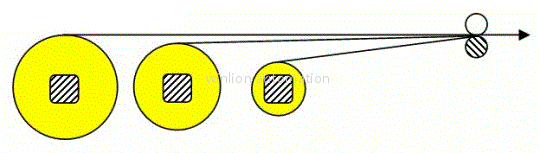
Multiple webs unwound together
On machines such as paper sheeters, several webs may be laid together and pulled through a common driven roller. Each unwind may have a different diameter. A separate tension-control system for every roll would be expensive and inconvenient to operate. An open-loop arrangement, or a combination of closed- and open-loop control, can use one tension system for this type of machine.
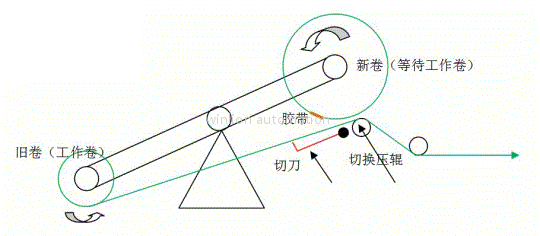
Non-stop twin-shaft roll changes
As the running roll approaches its end, the new roll accelerates until its surface speed matches line speed. The splice roller then presses the adhesive onto the moving web, and a knife separates the old roll. Tension must remain stable throughout the change. The same principle can also be applied to rewinding.
Winlion has supplied tension-control products and services to customers in China since the 1990s. We now provide complete production-line control systems as well as individual tension sections. For multi-section systems we generally use high-performance PLCs from SIEMENS or other manufacturers. Depending on the process, actuators may include electromagnetic brakes, vector drives, AC or DC servos, and pneumatic brakes.
Our services cover selection advice, electrical drawings, supply, and installation and commissioning support. We can also supply the complete electrical control system, including control panels and commissioning at the end user’s site.